 Skip to content
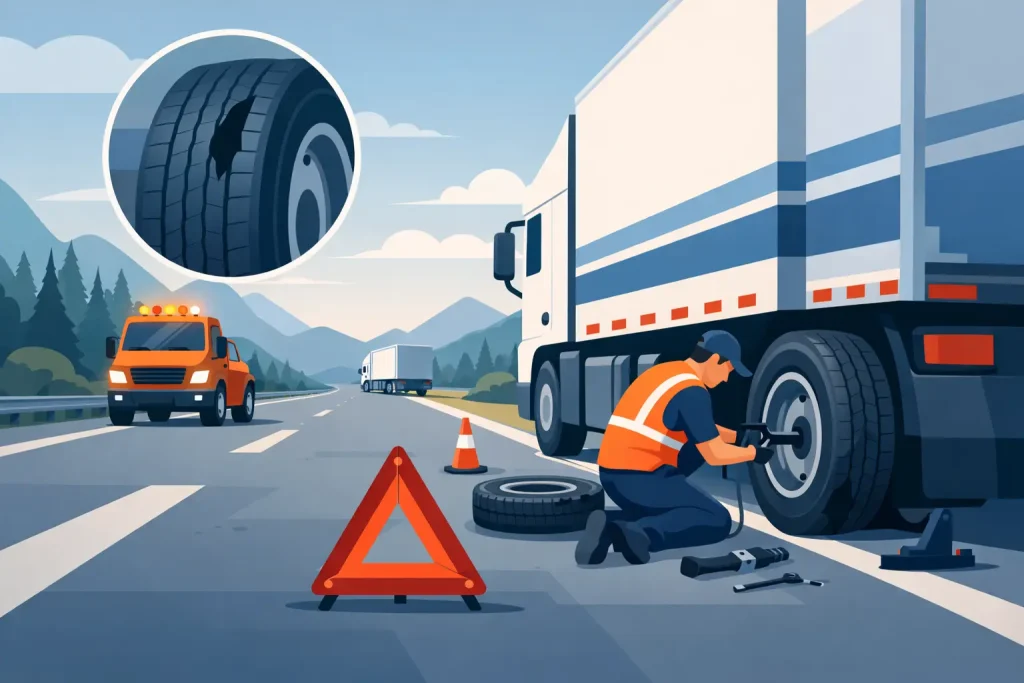
A tyre failure on a loaded lorry is not a job to rush, guess at or manage from the hard shoulder with unsuitable tools. This guide to lorry tyre emergencies explains what drivers and fleet managers should do first, what information a mobile tyre technician needs, and when a repair simply is not safe. The priority is always the same: protect people, secure the vehicle and get the right support moving.
Make the scene safe before thinking about the tyre
A blowout, rapid pressure loss or damaged tyre can affect steering, braking and vehicle stability in seconds. If the vehicle is moving, keep a firm grip on the wheel, avoid harsh braking where possible and reduce speed gradually. Do not make sudden steering corrections unless there is an immediate danger ahead.
Bring the vehicle to the safest available location. A lay-by, service area, depot entrance or other firm, level ground is far better than a live lane or narrow verge. On a motorway or major dual carriageway, follow the relevant road safety procedure and contact the appropriate emergency services or motorway control if the vehicle cannot be moved to a safe place.
Once stopped, apply the parking brake, switch on hazard warning lights and use other warning measures required by your operator’s safety policy. Keep passengers well away from traffic and out of the danger zone. With a coach or bus, that means managing people as carefully as the vehicle itself.
Do not inspect a damaged wheel from the traffic side. A tyre that has run flat can have internal damage that is not obvious from a quick look, and a hot tyre or wheel assembly needs particular caution. Give the technician a clear description from a safe position instead of taking risks to diagnose it yourself.
What counts as a lorry tyre emergency?
Not every loss of pressure looks dramatic. A tyre may still appear inflated while carrying a nail, suffering a valve problem or losing air slowly through rim corrosion. But a commercial vehicle puts huge loads through every wheel position, so a minor-looking issue can become a serious one quickly.
A tyre emergency commonly includes a blowout, a sidewall cut, a deep tread puncture, a tyre that has come off the bead, visible cords, a damaged valve, a cracked wheel, or a tyre that has been driven while substantially underinflated. Unusual vibration, pulling under braking, repeated pressure warnings or a thumping sound are also reasons to stop and assess the vehicle before damage worsens.
Twin-wheel setups need careful attention. If one tyre fails, it can overload its partner, create heat and make the whole wheel position unsafe. Equally, a tyre that looks usable beside a failed twin may have picked up debris or suffered overload damage. A proper inspection matters before the lorry returns to work.
A puncture is not automatically repairable
The location, size and cause of the damage determine whether a tyre can be repaired. A small, straightforward puncture in an approved tread area may be repairable if the casing has not been damaged by running flat. Damage in the shoulder or sidewall, exposed cords, a large tear, bead damage or signs of overheating normally point towards replacement.
This is where trying to save money can cost more. A repair that is not suitable for the tyre’s condition may lead to another roadside stop, downtime for the load and an avoidable safety risk. For fleet work, the right question is not just whether the tyre can hold air now, but whether it is safe and legal for the vehicle’s next journey.
Information to have ready when you call
The faster a technician can identify the vehicle, tyre and location, the better the chance of arriving with the correct replacement and equipment. A clear call also avoids wasted time when a vehicle is blocking a gate, delayed at a customer site or stopped on a route with access restrictions.
Have the vehicle registration, exact location, tyre size and wheel position ready if you can obtain them safely. Say whether it is a steer, drive, trailer, tag or lift axle tyre, and whether the vehicle is loaded. The tyre size is printed on the sidewall, but do not enter a live carriageway or unsafe area to read it.
It also helps to explain the type of damage and whether the vehicle has locking wheel nuts, a damaged wheel, air suspension issues or restricted access. Tell the operator if the vehicle is carrying passengers, temperature-controlled goods, hazardous loads or time-critical freight. These details affect the safest response and may determine whether the job needs a replacement tyre, specialist lifting equipment or recovery support.
For a fleet manager, provide a contact who can authorise the work. Waiting for approval after the technician is on site is a common source of delay, particularly outside normal office hours.
Why roadside tyre work needs the right equipment
Changing a commercial tyre is not the same as fitting a car tyre on a driveway. HGV, bus, coach, agricultural and earthmoving tyres are heavy, often high-pressure assemblies. Incorrect lifting, poor wheel handling or damaged studs can turn one tyre failure into a longer vehicle-off-road problem.
A capable mobile service should assess ground conditions, vehicle position, axle loading and wheel condition before starting. Soft verges, uneven depot yards and narrow roads all change how safely work can be carried out. Sometimes the most sensible decision is to move the vehicle a short distance under controlled conditions, or arrange recovery, rather than attempt a risky repair where it stands.
The replacement must also be suitable for the axle, application and load. Matching tyre size alone is not enough. Load rating, speed category, tread pattern, remaining tread on the paired tyre and the demands of the route all matter. A long-haul tractor unit, a local delivery lorry and a tipper working on rough ground have very different requirements.
Keeping the vehicle moving without cutting corners
Downtime is expensive, but a quick fix is only useful if it gets the vehicle back into safe service. A good roadside response balances speed with the checks that cannot be skipped. That includes examining the damaged tyre, checking the companion tyre on a twin setup, inspecting the rim where needed and fitting a tyre appropriate to the job.
For operators running mixed fleets, it is worth agreeing the approach in advance. Know who drivers should call, what authority they have for emergency spend, and where vehicle tyre records are held. Keeping current tyre sizes and wheel configurations against each registration can save valuable minutes on an overnight call-out.
Tyre pressure monitoring systems can help spot a developing issue, but they do not replace visual checks. A TPMS alert should be treated as an early warning, not ignored until the tyre is visibly flat. Likewise, repeated pressure loss should be investigated properly rather than topped up at every stop.
Preventing the next emergency
Some tyre failures cannot be predicted. Road debris, sudden impacts and severe potholes happen. Many call-outs, however, begin with issues that could have been caught at a depot check: low pressure, uneven wear, a lodged object, cracked valve hardware or damage to a sidewall.
Drivers should report vibration, steering changes and pressure warnings promptly. Fleet teams should keep inflation pressures, alignment, axle loads and tyre rotation under review. Overloading, poor alignment and sustained underinflation generate heat and wear at a rate that can shorten tyre life dramatically.
Pay attention to operating conditions too. Construction access roads, farm tracks, kerbing in urban deliveries and repeated tight manoeuvres all increase the chance of sidewall and shoulder damage. The best tyre choice is not always the cheapest purchase price. It depends on mileage, payload, road surface, fuel efficiency needs and how quickly a tyre must be available when something goes wrong.
A practical guide to lorry tyre emergencies for West Midlands fleets
For drivers working across Birmingham, Wolverhampton, Coventry, Walsall, Stafford and Worcester, the location of a breakdown can be as challenging as the tyre itself. A lorry at a busy industrial estate, a coach at a school collection point or an HGV on a motorway route needs a response that understands access, urgency and commercial vehicle requirements.
MMC Tyres provides direct mobile support for commercial and heavy vehicles, including lorries, HGVs, buses and coaches. Speaking directly to the owner means the details of the vehicle and the problem can be dealt with quickly, without being passed through a call centre. A clear quote, the correct tyre plan and a safe on-site assessment give drivers and operators a practical route back on the road.
When a tyre fails, focus on the next safe decision rather than the fastest-looking one. Get the vehicle secure, share accurate information and use properly equipped commercial tyre support. That approach protects the driver, the load, other road users and the working day that still needs to be completed.
