 Skip to content
It usually starts the same way. You notice a flat before work, pick up a screw on the school run, or realise a tyre is worn when the car is already parked up for the night. That is when the question becomes real: mobile tyre fitting vs garage – which one actually makes more sense when you need the job done properly and without wasting half your day?
For some drivers, a garage is still the right call. For plenty of others, especially when time matters or the vehicle cannot be moved safely, mobile fitting is the simpler option by a long way. The best choice depends on what has happened, where the vehicle is, and how quickly you need to get moving again.
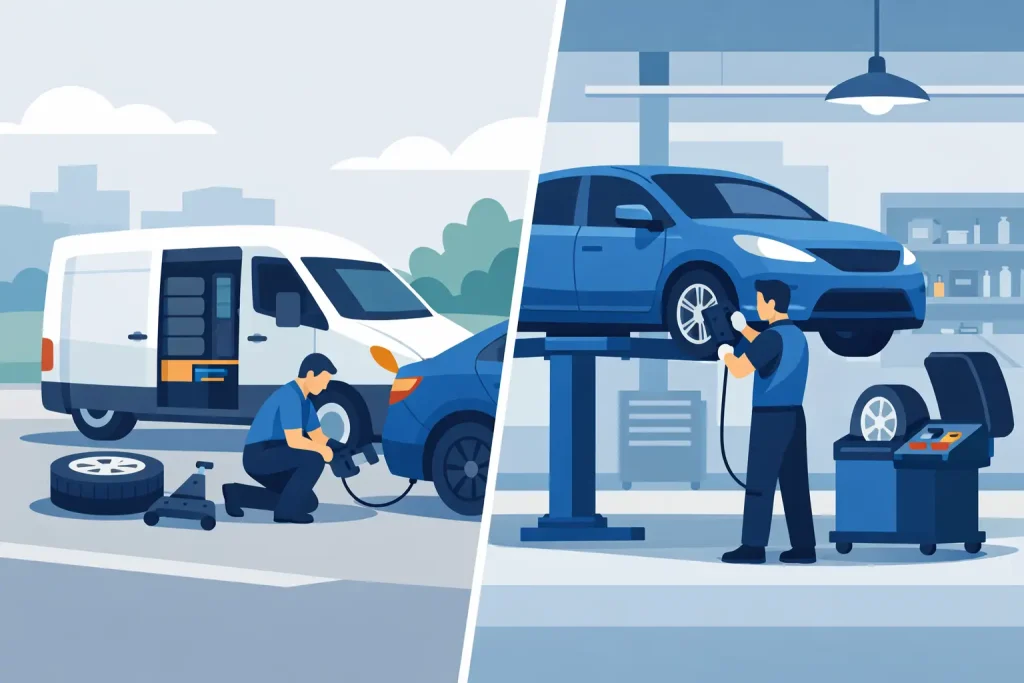
Mobile tyre fitting vs garage: the real difference
A garage asks you to bring the vehicle to them, wait your turn, and work around their opening hours. Mobile tyre fitting brings the service to your home, workplace, roadside location, depot or yard. That sounds like a small difference, but in practice it changes everything.
If your tyre has gone completely flat on the drive, getting to a garage may mean fitting the spare, risking damage by moving the vehicle, or arranging recovery. If you are stuck on a roadside, a garage is not much use unless you can reach it safely. Mobile support solves that problem first. The fitter comes out with the right equipment, replaces or repairs the tyre where the vehicle is, and gets you back on the road.
For planned jobs, the difference is about convenience rather than rescue. Instead of losing time travelling, sitting in a waiting area and rearranging your day, you can have tyres fitted while you are at home or carrying on at work.
When a garage still makes sense
There are times when a traditional garage is a perfectly reasonable option. If you are already nearby, the vehicle is safe to drive, and you prefer to book ahead for a routine tyre change, a garage can do the job well. Some motorists also like the familiarity of a workshop environment, especially if they are combining tyre work with MOT preparation, suspension checks or other mechanical repairs.
A garage may also suit drivers who are not in a hurry and have enough flexibility to drop the vehicle off. If your day is already free, the wait might not bother you.
That said, the hidden cost is often time. A tyre appointment at a garage is rarely just the fitting itself. It is the journey there, the queue, the waiting, and the journey back. For working drivers, parents, tradespeople and fleet operators, that disruption is often the biggest downside.
Where mobile tyre fitting comes into its own
Mobile fitting is at its best when the vehicle cannot or should not be driven, or when stopping work to visit a garage creates more hassle than the tyre job itself.
A puncture on the driveway is the obvious example. So is a blowout on a main road, a damaged tyre in a work car park, or a van sitting idle at a depot with a failed tyre first thing in the morning. In these situations, speed matters, but so does simplicity. You want one call, a clear quote, an honest ETA and a fitter who arrives ready to sort it.
That is why mobile services are especially useful for roadside emergencies, home visits, office car parks and commercial vehicles. The tyre problem gets handled where it happened, instead of becoming a transport problem on top of a tyre problem.
Cost: is mobile always more expensive?
This is where many people hesitate. They assume mobile means premium pricing. Sometimes there may be a call-out element, particularly for emergency work or out-of-hours attendance, but that does not automatically make it worse value.
A proper comparison is not just the invoice total. It is the full cost of getting the tyre sorted. With a garage, you may lose work time, pay for fuel, arrange recovery, or spend money and effort getting the vehicle there. If the tyre fails at an awkward time, the indirect cost can quickly overtake any small saving on paper.
Mobile fitting can be very competitive when you factor in convenience and speed. For urgent jobs, especially when the vehicle is off the road, it can actually be the more economical route because it removes the extra steps.
The sensible approach is to ask for a clear quote upfront. A good mobile fitter should tell you what the tyre costs, what the attendance charge is if any, and what your options are across premium, mid-range and budget tyres.
Speed and downtime
For most drivers, speed is the deciding factor in mobile tyre fitting vs garage. Not because the actual fitting takes much longer in a garage, but because the whole process usually does.
If you can drive to a workshop straight away and they can take you immediately, a garage can be quick enough. Real life is not always that tidy. Appointments fill up, walk-ins wait, and many garages keep standard business hours. Tyre problems do not.
Mobile fitting is built around reducing downtime. That matters to commuters who need to get to work, parents trying to keep the day on track, and operators with vans, buses, coaches or lorries that cannot afford to sit still. The shorter the delay, the less the tyre issue spreads into the rest of your day or your business.
Safety and practicality
Not every tyre issue should involve driving to a garage. A tyre with severe sidewall damage, a rapid loss of pressure or a complete blowout can make the vehicle unsafe to move. Even if it looks like a short journey, the risk is not worth it.
Mobile support removes that decision. The vehicle stays where it is until the fitter has assessed it. If the tyre is repairable, that can be dealt with there and then. If it needs replacement, the correct tyre can be fitted on site.
This is particularly important for heavier vehicles and working fleets. A van or lorry off the road is not just an inconvenience. It affects deliveries, schedules and customer commitments. Getting support to the vehicle is often the most practical response.
Routine fitting versus emergencies
Some people think mobile fitting is only for breakdowns. It is not. It works just as well for planned replacements, seasonal tyre changes and scheduled fleet maintenance.
If your tyres are nearing the legal limit, booking a mobile visit can be the easiest way to stay ahead of the problem. The vehicle gets dealt with at home or at work, and you do not need to carve out part of the day for a garage appointment.
For emergencies, though, mobile fitting has a clear edge. When the vehicle is stranded, when the spare is missing or unusable, or when you are dealing with an urgent failure outside normal hours, having someone come to you is simply the more direct solution.
What fleet operators and commercial drivers should consider
For commercial users, the choice is usually less about preference and more about lost operating time. A garage visit means taking the vehicle out of service, sending a driver to the workshop and waiting for completion. That might be manageable for one car. It is much more disruptive for vans, minibuses, coaches or heavy vehicles.
Mobile tyre support allows work to continue around the repair. A van can be fitted at the depot before a route starts. A vehicle in a yard does not need to be moved. An HGV or coach with a tyre issue can be assessed where it stands. For operators managing several vehicles, that flexibility is often more valuable than anything else.
This is one reason local businesses across the West Midlands increasingly rely on mobile support for both emergency and planned tyre work. The service fits around the operation, not the other way round.
Choosing the right option for your situation
If your car is driveable, you have time to spare, and you are already near a workshop, a garage may do the job perfectly well. If the tyre is unsafe, the vehicle is stuck, your schedule is packed, or you need help outside standard opening hours, mobile fitting is usually the better answer.
The key is to be honest about the real situation. Can the vehicle be moved safely? How much time will the garage trip actually take? What is the cost of that delay? Once you look at those questions properly, the decision is often straightforward.
For drivers who want quick, direct help without call centres, workshop queues or unnecessary delays, a local mobile service is hard to beat. MMC Tyres works that way because when a tyre fails, most people do not want a complicated process. They want a real person, a fair quote and someone on the way.
A tyre problem is stressful enough without turning it into a half-day errand. The best option is the one that gets you safe, sorted and moving again with the least disruption – and for a lot of drivers, that means having the fitter come to them.
